• LICENSED WASHINGTON (01) MASTER ELECTRICIANS

240V EV Charger Installation Spokane, WA

Dedicated 30A to 60A high-voltage branch circuits, heavy-duty industrial NEMA 14-50 & 6-50 receptacles, hardwired continuous-duty EVSE engineering, City of Spokane permits & Avista utility rebate management.

Request 240V Quote

Fixed upfront pricing & Avista rebate verification

WA (01)
Licensed Master Electricians
100%
City of Spokane Code Compliant
$1,000
Avista Rebates Handled
500+
Spokane Installations Completed

Professional 240V EV Charger Installation Across Spokane, WA

Electric vehicle ownership across the Inland Northwest is expanding at an unprecedented pace. Whether you drive a Tesla Model Y, Ford F-150 Lightning, Rivian R1T, Hyundai Ioniq, or Chevrolet Equinox EV, the foundational requirement for fast, reliable, and convenient home charging is a dedicated 240-volt electrical circuit.

Attempting to charge a modern electric vehicle using an ordinary 120-volt household wall outlet (Level 1 trickle charging) is painfully slow. Delivering only 1.0 to 1.4 kilowatts of power, a 120V outlet adds a meager 2 to 4 miles of driving range per hour of charging. To replenish an empty 75 kWh battery pack on 120V power takes over 50 to 60 continuous hours. During Spokane's freezing winter months, sub-freezing temperatures can halt 120V charging entirely because incoming power is diverted to heat the battery pack.
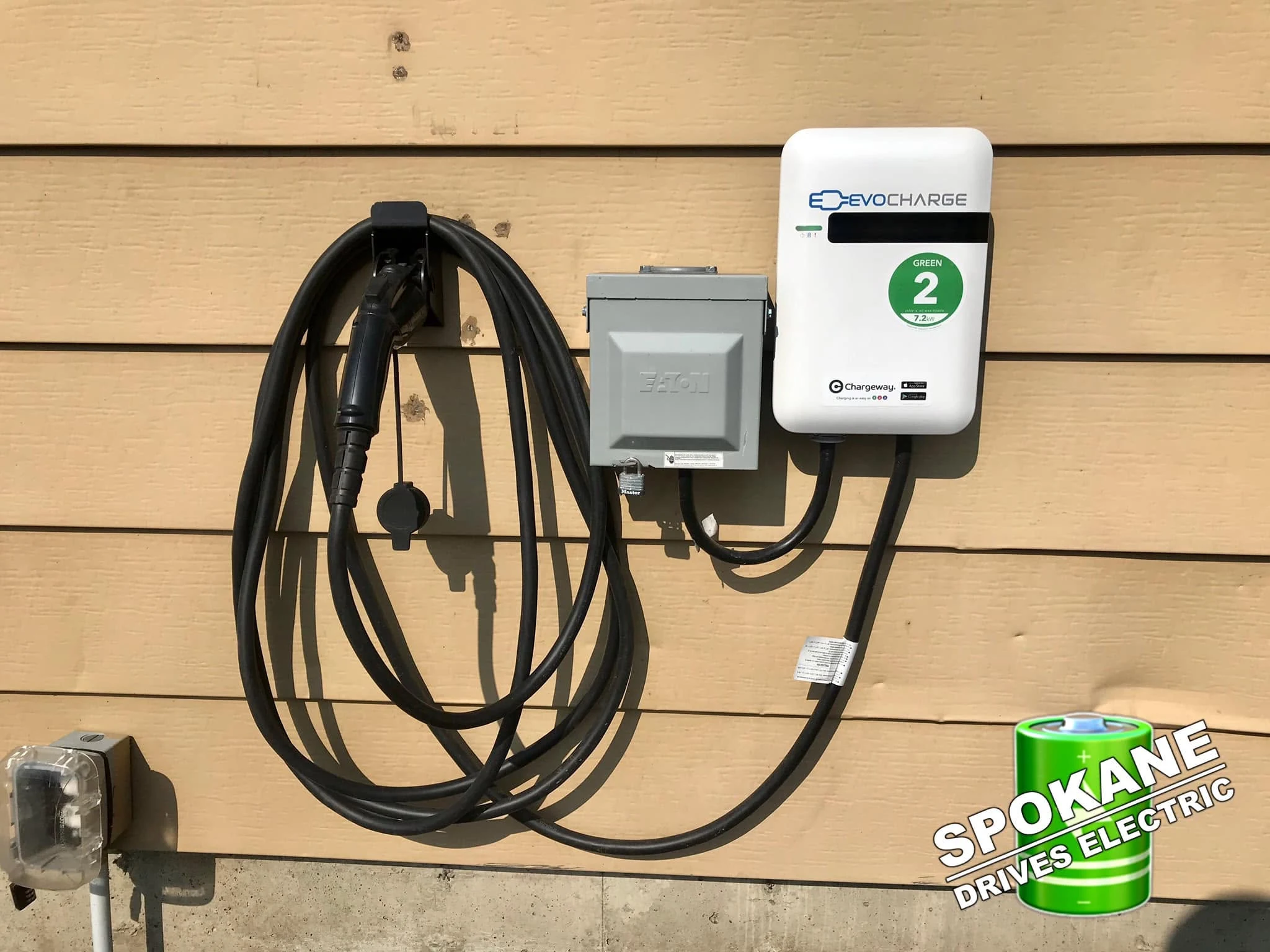
Dedicated 240V EV Charger Circuit Installation in Spokane WA
Dedicated 240V Continuous Duty Circuit Installation • Licensed WA (01) Master Electricians
OVERNIGHT REPLENISHMENT

The 240V Level 2 Speed & Winter Advantage

Installing a dedicated 240-volt circuit permanently solves the charging bottleneck. Operating at four to eight times the power delivery of a standard wall outlet, a 240V Level 2 charging circuit supplies between 7.2 kW and 11.5 kW of electrical power, replenishing 25 to 45 miles of range per hour of charging. You can return home in the evening with an empty battery, plug in, and wake up every morning to a completely replenished 100% battery pack.

NEC ARTICLE 625 MANDATE

Continuous Duty Load Engineering

Under the National Electrical Code, an EV charging station is classified as a continuous electrical load. Pulling 32 to 48 continuous amperes for hours at a time places severe thermal stress on your service panel, circuit breakers, copper wiring, and terminal lugs. Our certified electricians specialize in dedicated 240V infrastructure, load calculations, City of Spokane permits, and Avista utility rebates for maximum lifetime safety.

⚡

Dedicated 240V Circuits

Custom-engineered 30A, 40A, 50A, and 60A branch circuits designed specifically for high-amperage continuous duty cycles.

🔌

Hardwired & Plug-In

Expert installation of permanently hardwired charging stations or heavy-duty industrial NEMA 14-50 and 6-50 receptacles.

📋

Permitting & Compliance

Turnkey electrical permitting and municipal safety inspections handled via City of Spokane, Spokane Valley, or Washington L&I.

💰

Utility Rebate Filing

Capture up to $1,000 in regional Avista Utilities electric transportation incentives and 30% federal clean energy tax credits.
What Is a Dedicated 240-Volt Circuit? The Physics of Voltage & Amperage

To understand why a dedicated 240V circuit is required for electric vehicle charging, it helps to understand basic residential electrical physics.

OHM'S LAW POWER FORMULA
Power (Watts) = Voltage (Volts) × Current (Amps)
Standard 120V Circuit: 120V × 12A continuous = 1,440 Watts (1.44 kW) → Adds 2–4 mph
Dedicated 240V Circuit: 240V × 48A continuous = 11,520 Watts (11.52 kW) → Adds 40–48 mph

120 Volts vs. 240 Volts: Double the Electrical Pressure

In American residential electrical systems, power enters from Avista Utilities as single-phase 120/240-volt alternating current (AC) across two energized "hot" busbars and one neutral:

  • Standard 120V Circuit (Single-Pole): Powers ordinary lamps, computers, and small appliances. Connects to one hot busbar and one neutral wire (120V × 12A = 1,440 Watts = 1.44 kW).
  • Dedicated 240V Circuit (Double-Pole): Powers heavy-duty appliances like central air conditioners, electric ranges, and EV chargers. A double-pole circuit breaker bridges across both 120V busbars simultaneously, delivering 240 volts of electrical pressure (240V × 48A = 11,520 Watts = 11.52 kW).

By doubling the electrical voltage and quadrupling the amperage, a 240V circuit delivers up to 8 times more energy per hour into your vehicle's battery pack than a standard wall outlet.

The Absolute Mandate for a "Dedicated" Circuit

National Electrical Code (NEC Article 625) strictly mandates that electric vehicle charging equipment must be served by an individual, dedicated branch circuit:

  • Zero Shared Loads: A dedicated branch circuit feeds only one piece of equipment: the EV charger. It cannot share wiring, junction boxes, or circuit breakers with garage lighting, garage door openers, air compressors, or general convenience outlets.
  • Why Tapping Existing Outlets Is Prohibited: Attempting to tap into an existing 240V clothes dryer or water heater circuit creates extreme fire and overcurrent hazards. If the clothes dryer and EV charger cycle simultaneously, the circuit will immediately overload, tripping the breaker or overheating conductors hidden inside wall cavities.

Our electricians route clean, direct EMT conduit from your panel directly to your charging stall, ensuring zero shared loads and complete safety.

Hardwired 240V Circuit vs. 240V Receptacle Outlets: Key Differences

When installing a 240V EV charging circuit, Spokane homeowners must choose between two distinct installation approaches: a permanently hardwired charging station or a 240-volt plug-in receptacle.

Technical & Operational Metric Hardwired 240V EV Installation Plug-In 240V Receptacle (NEMA 14-50) Detailed Engineering Analysis
Maximum Continuous Current 48 Amps Continuous (11.5 kW) 40 Amps Continuous (9.6 kW) Electrical code limits plug-in appliances to 80% of a 50A breaker (40A max). Hardwiring supports full 48A charging on a 60A breaker.
Miles of Range Added Per Hour 40 to 45 miles per hour 25 to 30 miles per hour Hardwiring charges up to 45% faster, replenishing a full battery in 5 to 6 hours.
Circuit Breaker Required Standard 60A Double-Pole ($25 – $35) GFCI Double-Pole 50A Breaker ($120 – $180) 2023 NEC code strictly mandates GFCI breakers on garage receptacles. Hardwired units bypass this cost.
Nuisance Tripping Risk Zero Risk High Risk Dual GFCI logic conflict: EVSE internal ground fault hardware clashes with panel GFCI breaker, causing midnight shutoffs.
Mechanical Failure Points None. Wires seat into torqued lugs. High Risk if using cheap outlet. Friction plug prongs expand and contract under continuous heat, loosening over time and causing outlet melting.
Outdoor Weather Sealing NEMA 3R / NEMA 4X Watertight Requires In-Use Bubble Cover Hardwiring provides a completely sealed conduit connection, vastly superior for outdoor driveway mounting.
Portability & Mobility Fixed to wall (removable with tools) Unit unplugs easily for road trips Plug-in is advantageous for renters or RV travelers who use mobile cords at campgrounds.

Master Electrician Recommendation for Spokane Homes

For permanent single-family home installations in Spokane, we strongly recommend hardwiring your EV charger on a dedicated 60-amp circuit. Hardwiring unlocks maximum 48-amp continuous speed, eliminates the $150 GFCI breaker requirement, and completely prevents nuisance tripping during winter overnight charging.

NEMA Receptacle Configurations Compared: 14-50, 6-50, 14-30 & 6-20

If you opt for a plug-in 240V installation, choosing the correct NEMA receptacle configuration depends on your charging equipment, vehicle mobile cord adapters, and available panel capacity.

14-50

NEMA 14-50

THE UNIVERSAL STANDARD

50A, 4-Prong Receptacle (Hot/Hot/Neutral/Ground). Max continuous EV draw: 40 Amps (9.6 kW). Delivers ~30 to 38 mph. Compatible with Tesla, Ford, and universal portable Level 2 chargers. Ideal for RV travelers charging at campgrounds.

6-50

NEMA 6-50

THE WELDER OUTLET

50A, 3-Prong Receptacle (Hot/Hot/Ground; no neutral). Max continuous EV draw: 40 Amps (9.6 kW). Common in home workshops. Pulls only 3 conductors (#6/2 with ground) instead of 4, saving ~25% on copper wire material costs.

14-30

NEMA 14-30

CLOTHES DRYER / 100A PANELS

30A, 4-Prong Receptacle (Hot/Hot/Neutral/Ground). Max continuous EV draw: 24 Amps (5.8 kW). Perfect low-cost solution for older Spokane homes with 100A panels. Adds 18–22 mph (160+ miles overnight) without a $4,000 panel upgrade.

6-20

NEMA 6-20

COMPACT 240V CIRCUIT

20A, 3-Prong Receptacle with horizontal T-slot blade. Max continuous EV draw: 16 Amps (3.8 kW). Ultra-economical upgrade using standard #12 AWG wire and 20A breaker. Delivers 12–15 mph—3 to 4 times faster than a standard wall outlet.

The Builder-Grade Outlet Melting Hazard: Industrial Receptacles Are Essential

If you choose a NEMA 14-50 plug-in installation, the physical quality of the receptacle is a critical life-safety consideration. Standard hardware home improvement stores sell residential-grade NEMA 14-50 outlets manufactured by Leviton or Pass & Seymour for $10 to $15.

These consumer outlets are engineered for electric kitchen stoves and clothes dryers—appliances that draw high amperage intermittently for 20 to 45 minutes at a time. They were never designed for the sustained 8-hour continuous thermal loads demanded by modern electric vehicles.

Industrial Grade Hubbell 14-50 EV Receptacle Wiring Spokane
Industrial Specification Receptacle & EMT Conduit Wiring • Zero Melting Risk
RESIDENTIAL GRADE FAILURE MODE

Why Cheap $10 Outlets Catch Fire Under EV Loads

When an electric vehicle pulls a continuous 32 to 40 amperes for 8 consecutive hours, the thin stamped-brass contacts inside cheap builder-grade outlets suffer thermal expansion and spring fatigue. The mechanical clamping pressure holding the plug prongs degrades, creating micro-arcing and intense localized electrical resistance. Across Spokane County, electrical contractors regularly replace charred, melted builder-grade outlets that have caught fire inside garage walls.

THE PROFESSIONAL CONTRACTOR STANDARD

Hubbell HBL9450A & Bryant 9450FR Industrial Receptacles

Licensed electrical contractors strictly install heavy-duty industrial specification receptacles ($80 to $120 hardware component cost):

  • Reinforced Glass-Filled Thermoplastic: Bodies withstand temperatures exceeding 250°F without charring.
  • Massive Solid Brass Jaws: Wrap completely around plug prongs, maintaining permanent spring tension over thousands of cycles.
  • Screw-Clamp Terminals: Ensure copper conductors are torqued with digital screwdrivers to exact code-mandated ratings.

Conductor Sizing & Wire Specifications: The 80% Rule & Romex Derating

The foundational engineering principle governing 240V EV branch circuit wiring is National Electrical Code (NEC) Article 625: EV charging equipment is classified as a continuous electrical load.

NEC 625.42 & 210.20 OVERCURRENT PROTECTION RULE
Required Breaker Size = Continuous Operating Amperage × 1.25 (125%)
Continuous EV Draw (Amps) Required Breaker Size (125%) Minimum Copper Conductor (THHN in EMT Conduit) Romex NM-B Cable Size (60°C Column Derated) Power Delivery (@ 240V) Typical Miles Added / Hour
16 Amps 20 Amp Breaker #12 AWG Copper #12 AWG Romex 3.8 kW 12 – 15 miles
24 Amps 30 Amp Breaker #10 AWG Copper #10 AWG Romex 5.8 kW 18 – 22 miles
32 Amps 40 Amp Breaker #8 AWG Copper #8 AWG Romex 7.7 kW 25 – 30 miles
40 Amps 50 Amp Breaker #6 AWG Copper #6 AWG Romex (Max 44A) 9.6 kW 30 – 38 miles
48 Amps 60 Amp Breaker #6 AWG THHN Copper #4 AWG Romex (Mandatory) 11.5 kW 40 – 48 miles

The Critical #6 Romex Wire Temperature Derating Trap

A frequent, dangerous code violation committed by unqualified installers involves wiring a 48-amp EV charger using standard #6 AWG Romex (NM-B cable) on a 60-amp circuit breaker. Under NEC Article 334.80, Romex is legally restricted to the 60°C temperature column, rating #6 Romex for a maximum of only 55 amperes. Connecting #6 Romex to a 60-amp breaker violates Washington State electrical code and creates a severe hidden wall cavity fire hazard. If Romex cable is pulled, code strictly mandates upgrading to heavy #4 AWG Romex.

Circuit Breakers & The 2023 NEC GFCI Mandate for Garage Receptacles

Recent revisions to the National Electrical Code adopted across Washington State have fundamentally altered how 240-volt garage outlets must be protected.

⚠️

The 2023 NEC GFCI Mandate & Nuisance Tripping Conflict

Under current electrical code (NEC 210.8), all 240-volt receptacles installed in residential garages, carports, and outdoor locations must be protected by an approved Ground Fault Circuit Interrupter (GFCI) breaker ($120 to $180 component cost).

However, modern EV charging stations (including Tesla Mobile Connector, ChargePoint, and Grizzl-E) have sensitive internal GFCI monitoring electronics built directly into the unit. When plugged into a GFCI-protected outlet, both systems pulse test signals through the ground wire simultaneously. These signals clash, creating nuisance tripping that shuts off power in the middle of the night—leaving you stranded with an uncharged vehicle.

✓

The Hardwired Solution: Zero Nuisance Tripping

Because a hardwired Level 2 charging station is permanently connected via continuous conduit rather than a plug, Washington electrical code does not require an upstream GFCI circuit breaker.

The hardwired installation utilizes a standard, highly reliable $25 double-pole 60A circuit breaker. This eliminates dual-GFCI signal conflicts entirely, guaranteeing 100% uninterrupted charging reliability through freezing Spokane nights while saving homeowners over $100 in breaker hardware costs.

Evaluating Your Spokane Electrical Panel for a 240V Circuit

Before installing a 240V EV branch circuit, a licensed electrical contractor must evaluate your property's electrical service capacity.

A home does not automatically need a 200-amp service simply because an EV charger uses 240 volts. The determining factor is an NEC Article 220 demand load calculation. If your Spokane home has a 100-amp panel but uses natural gas for central space heating, water heating, and cooking, an electrical assessment will frequently show 30 to 40 amperes of available electrical headroom.

Spokane 200A Electrical Panel Modernization for EV Charging
200A / 400A Service Heavy-Up & Whole-Home Surge Protection • Spokane, WA
COST-SAVING HEADROOM AUDIT

When a 100-Amp Panel Is Fully Sufficient

In homes with natural gas heating and cooking, an electrician can safely install a 24A or 32A 240V circuit without spending thousands on a panel replacement. Drawing 24A on a 30A circuit delivers 18 to 22 miles of range per hour—replenishing over 160 miles overnight—while staying strictly within electrical code load limits.

SAFETY & CAPACITY MANDATES

When a 200A Service Heavy-Up Is Required

A main service panel modernization ($2,600 to $4,500) becomes necessary if:

  1. Your home has an all-electric heating system (heat pump with auxiliary heat strips, electric water heater, electric range).
  2. The panel busbars are physically damaged, corroded, or overcrowded with zero open breaker slots.
  3. The panel is an obsolete, uninsurable brand such as Federal Pacific Electric (FPE Stab-Lok) or Zinsco.

Conduit Pathways & Detached Garage Engineering

In electrical contracting, the physical route from your electrical panel to the charging location dictates both installation aesthetics, code compliance, and total labor costs.

• 5 Code-Compliant Routing Pathways ↕ Scroll through pathways
1

Surface-Mounted EMT Steel Conduit in Garages

When the electrical panel is in an attached garage, our standard installation utilizes Electrical Metallic Tubing (EMT) steel conduit surface-mounted along wall framing. EMT provides commercial-grade impact protection against car doors, ladders, and tools while presenting a clean industrial look.

2

Unfinished Basements & Crawlspaces

In mid-century Spokane homes where the electrical panel is located in an unfinished basement, technicians route armored metal-clad (MC) cable or drill through floor joists beneath living spaces, popping up directly through the garage floor plate into the charging station.

3

Avoiding Finished Drywall Sheetrock Repairs

Crossing finished drywall ceilings can require cutting multiple messy holes. Our experienced contractors save homeowners hundreds of dollars in drywall patching by routing conduit along the exterior foundation perimeter or fishing through attic trusses.

4

Detached Garages: 24-Inch Frost Line & Basalt Rock Excavation

Washington electrical code mandates that Schedule 40 PVC conduit must be buried at a minimum depth of 24 inches beneath finished grade. On the South Hill and Five Mile Prairie, solid volcanic basalt rock sits 4 to 8 inches down. We deploy rotary diamond rock saws and hydraulic rock breakers to trench to legal code depth.

5

Dedicated Subpanel & Voltage Drop Upsizing

Running a feeder 100 to 200 feet from a house panel to an alley garage introduces resistance that drops voltage. To prevent voltage sag under continuous 48-amp charging, we upsize conductors to #4 or #2 AWG and install a dedicated 60A to 100A garage subpanel.

Detached Garage EV Charger Underground Trenching Spokane
Subterranean Conduit Run & Subpanel Installation • Spokane Detached Garages

Spokane Permitting, Municipal Codes & Inspection Protocols

Installing a 240V continuous-load circuit in Washington State is strictly regulated by state law (RCW 19.28) and municipal building codes. Non-permitted electrical work compromises homeowner insurance coverage and creates severe liabilities during future property sales.

🏛️

City of Spokane

Development Services Center (City Hall, 808 W Spokane Falls Blvd). Governs all residential and commercial electrical permits inside incorporated City of Spokane boundaries.

🏢

City of Spokane Valley

Building & Planning Department (10210 E Sprague Ave). Governs dedicated EV charging branch circuits and service upgrades within Spokane Valley municipal limits.

🌲

Washington State L&I

Department of Labor & Industries (901 N Monroe St). Governs unincorporated Spokane County communities including Mead, Colbert, Liberty Lake, Cheney, and Medical Lake.

The 10-Point Electrical Safety Inspection Walkthrough

During on-site municipal walkthroughs, inspectors rigorously verify: 1) Conductor sizing matching breaker ratings; 2) Calibrated lug torquing (NEC 110.14D) using digital screwdrivers; 3) EMT conduit strapped within 12" of enclosures and every 3 ft; 4) Proper GFCI breaker integration on all garage receptacles; and 5) Clear panel directory labeling ("240V EV Charger"). Every project we execute passes inspection on the initial walkthrough.

240V EV Charger Installation Cost Breakdown in Spokane

Transparency in pricing helps Spokane homeowners budget accurately. Because every home's panel capacity, wire distance, and architecture differ, installation costs fall across several distinct tiers.

240V Installation Scope Tier Typical Labor & Materials Cost Scope Details & Included Materials Typical Spokane Application
Tier 1: Standard Attached Garage Circuit $550 – $950 Dedicated 40A–60A breaker, up to 15 ft of surface EMT conduit, #6 THHN copper wire, mounting, commissioning, and City permit. Modern suburban homes in Five Mile Prairie, Southgate, or Wandermere with panels in the garage.
Tier 2: Intermediate Basement / Crawlspace Run $850 – $1,650 Up to 50 ft of wiring routed through unfinished basements, crawlspaces, or attics; structural framing drilling; junction boxes; permit. Mid-century ranches in North Hill, Balboa, Shadle, or Town & Country with basement panels.
Tier 3: Finished Ceiling / Opposite Side Run $1,250 – $2,200 50–90 ft of conduit routed through finished drywall ceilings, exterior wall penetrations, surface raceways, or attic fishing; permit. Multi-level homes in Comstock, Lincoln Heights, or Spokane Valley with finished living spaces.
Tier 4: Detached Carriage Garage & Trenching $2,200 – $4,500+ 60A–100A subpanel, 50–150 ft subterranean trenching, heavy conduit, large-gauge wire, navigating Spokane basalt rock shelves. Historic properties in Browne's Addition, South Hill (Manito, Cliff/Cannon), or West Central.
Main 200-Amp Service Panel Upgrade $2,600 – $4,500 New 200A exterior meter base, main disconnect, 200A interior distribution panel, whole-home surge protector, Avista coordination. Older Spokane homes with 60A/100A panels, full breaker boxes, or hazardous Federal Pacific/Zinsco panels.
Attached Garage Standard
$550 – $950
  • Dedicated 40A–60A Double-Pole Breaker
  • Up to 15 ft Surface EMT Steel Conduit
  • #6 THHN Solid Copper Conductors
  • Industrial Receptacle or Hardwire Terminal
  • City or State Electrical Permit Included
Select Package
200A Service Heavy-Up
$2,600 – $4,500
  • New 200A Heavy-Duty Commercial Meter Base
  • 40-Circuit Interior Distribution Panel
  • Whole-Home Surge Protection (Type 2 SPD)
  • Avista Utility Disconnect / Reconnect
  • Final City Electrical Safety Sign-Off
Select Package

Avista Rebates, Washington Clean Energy Incentives & Tax Credits

Substantial regional, state, and federal incentives are available to offset the upfront cost of your 240V EV charger installation.

⚡

Avista Utilities (Schedule 77)

Residential rebates between $500 and $1,000 for qualifying Level 2 smart charging stations on dedicated 240V circuits. Income-qualified households can receive enhanced rebates covering up to 100% of installation expenses.

🏛️

WA Sales Tax Exemption

Under Washington State law (RCW 82.08.816), equipment and professional installation labor associated with electric vehicle charging infrastructure are exempt from state and local sales taxes, saving approximately 9% on total project expenses.

💵

Federal Section 30C Credit

The federal Inflation Reduction Act provides the Alternative Fuel Vehicle Refueling Property Credit: claim a federal tax credit equal to 30% of hardware and installation expenses, up to $1,000, in eligible Spokane County census tracts.

Winter Durability & Cold Weather Engineering for 240V Equipment

Spokane winters place extreme demands on outdoor and unheated garage electrical equipment. To maintain peak charging performance and battery health, your 240V installation incorporates cold-weather engineering best practices.

❄️

Cold-Rated Rubber Cables

Standard PVC charging cables become stiff and brittle at 10°F. We install equipment equipped with specialized rubberized neoprene cables rated to -40°F (-40°C) that remain fully pliable and easy to handle in sub-zero freezes.

🔋

Morning Preconditioning

A dedicated 240V circuit allows your vehicle to "precondition" (warm the battery pack and heat the cabin to 72°F) using home grid power before your morning commute, preserving 100% of your rated battery range and restoring full regenerative braking.

🛡️

Weatherproof NEMA 4X

Outdoor driveway installations require NEMA 3R or NEMA 4X weather-sealed enclosures and liquid-tight conduit fittings to prevent blowing snow and freezing rain from corroding electrical terminals.

What Spokane EV Owners Say

★★★★★ 4.9/5 Average Rating (500+ Local Installs)
★★★★★

"Installed a 240V 50-amp circuit with an industrial Bryant outlet in our South Hill garage. Clean EMT conduit run along the foundation, passed City inspection on the very first walkthrough, and helped us submit the paperwork to get $500 back from Avista."

MD
Mark & Elena D.
South Hill, Spokane WA
★★★★★

"Our 1960s daylight ranch had a 100A panel with no spare breaker space. Instead of forcing an expensive $4,000 panel replacement, they performed an NEC load calculation and installed a dedicated 24A 240V circuit. Charges our Ford F-150 Lightning perfectly overnight."

TH
Thomas H.
Five Mile Prairie Homeowner

Frequently Asked Questions

Everything Spokane homeowners and property managers need to know about 240V dedicated circuits, breaker sizing, and municipal permits.

Speak With An Electrician
What is the difference between a 120V and 240V EV charger? +

A 120V charger (Level 1) plugs into a standard household wall outlet and delivers 1.0 to 1.4 kW, adding only 2 to 4 miles of range per hour. A dedicated 240V charger (Level 2) delivers 7.2 kW to 11.5 kW, replenishing 25 to 45 miles of range per hour and providing a complete overnight recharge in 4 to 8 hours.

Can I plug an EV charger into an existing 240V clothes dryer outlet? +

While technically possible if the plug configuration matches (e.g., NEMA 14-30), it is generally inconvenient and potentially hazardous. Clothes dryer outlets are located in laundry rooms, far from garages, and standard dryer outlets are not engineered for the continuous daily plugging cycles required by electric vehicles. Installing a dedicated 240V circuit in your garage is vastly safer and more practical.

Do I need a permit to install a 240V EV charger in Spokane, WA? +

Yes, absolutely. Under Spokane Municipal Code 17F.050.020 and Washington State law (RCW 19.28), all new 240-volt electrical branch circuits, high-voltage receptacles, and EV charging stations require an official electrical permit and on-site safety inspection. Unpermitted work violates state law and voids homeowner insurance coverage in the event of an electrical fire.

How much does it cost to install a 240V outlet for an EV charger in Spokane? +

Installing a dedicated 240V NEMA 14-50 outlet in an attached garage typically costs between $550 and $1,100 for professional labor, industrial-grade receptacle, GFCI circuit breaker, conduit, copper wire, and city permits. Long wire runs across finished basements or trenching to detached garages range between $1,500 and $4,000+.

Why do cheap NEMA 14-50 outlets melt during EV charging? +

Standard $10-$15 hardware-store outlets are engineered for electric kitchen stoves and clothes dryers that cycle power intermittently. An electric vehicle draws heavy current continuously for 8+ hours. This continuous heat causes thin brass contacts to expand, loosen, and arc, melting the outlet. Electricians strictly install industrial-grade Hubbell or Bryant receptacles engineered for continuous thermal duty.

What size breaker is needed for a 240V EV charger? +

Under National Electrical Code continuous load rules (NEC 625), circuit breakers must be sized at 125% of the charger's continuous draw: 48A continuous -> 60 Amp Breaker (Must be hardwired); 40A continuous -> 50 Amp Breaker (Maximum allowed on NEMA 14-50 plug); 32A continuous -> 40 Amp Breaker; 24A continuous -> 30 Amp Breaker.

Can my 100-amp electrical panel support a 240V EV charger? +

In many cases, yes. If your Spokane home utilizes natural gas for central heating, domestic water heating, and cooking, an NEC Article 220 load calculation will often show sufficient headroom to add a 24A or 32A 240V circuit without requiring an expensive panel upgrade.

How long does a typical 240V circuit installation take? +

A standard residential 240V circuit installation where the panel is located in the garage typically takes 2 to 4 hours. Complex projects involving underground trenching across a yard to a detached garage, subpanel installations, or main service panel upgrades generally require 1 full working day.

Schedule Your Spokane 240V EV Circuit Assessment

Never compromise on your vehicle's charging speed, battery longevity, or your home’s electrical safety. Whether you drive a Tesla, Ford Lightning, Rivian, Hyundai, Chevrolet, or BMW electric vehicle, our licensed Washington master electricians deliver precision, 100% code-compliant 240V dedicated circuit installations.

What to Have Ready When You Call:

  • Your Vehicle Make & Model: Determines target charging amperage and circuit sizing.
  • Location of Your Electrical Panel: Attached garage, basement, utility room, or exterior meter.
  • Main Circuit Breaker Size: 100A, 150A, or 200A labeled on the large main switch.
  • Desired Charger Mounting Location: Inside garage bay, exterior driveway wall, or detached carriage house.
📞
DIRECT PHONE LINE
✉️
EMAIL INQUIRIES
service@evchargerspokane.com
📍
HEADQUARTERS
Spokane, WA 99201

Request 240V Assessment

Free consultation with certified Spokane master electricians

📞 Call Licensed Electrician: +1 509 800 4136